


Over my 30+ years as a charter guide, and now through our social media, emails and course community, one of the most common questions I get asked is: “What fish finder should I buy?”
MYTH BUSTER…
Funnily enough, that question in itself is not that helpful when looking for the best sounder/fish finder setup.
Because the critical thing when looking for a new sounder/fish finder is not the head unit, but what TRANSDUCER to go with it.
Sounder VS Fish Finder
For the uninitiated, the world of fish finding sonar can be a minefield. It seems every brand has a different term for the same thing (e.g. side scan, side view, side image) and even the units have different names (e.g. fish finder, sounder, bottom machine, depth finder, sonar).
The most common terms: fish finder and sounder mean exactly the same thing. A unit that uses sonar technology to “see” what is under your boat.

Why The Transducer Matters More Than The Head Unit
Before we get into the different options, it helps to understand why I keep banging on about the transducer.
I explain that visually in the video below, using a few simple inshore and offshore examples. If you’re new to sounders or fish finders, watch this first. It will make the rest of this guide make a lot more sense.

The Simple Order For Choosing A Sounder/Fish Finder Setup
Don’t start by asking which fish finder to buy because it has the flashiest screen.
Start by working out where you mainly fish and what you need the sounder to show you. Then choose the transducer that suits that job. After that, choose a head unit that can drive that transducer properly and gives you the features you actually need.
So the buying order should look more like this:
- Define your target area and style of fishing.
- Match the right transducer to that job.
- Choose the sounder head unit to suit the transducer.
This is why asking “what fish finder to buy?” can be tricky. The best fish finder in Australia is not one single unit. It depends on the fishing you do, the depth you fish, the transducer you need and whether the head unit can run it properly.
Step 1: Define Your Target Area And Style Of Fishing
Before you worry about brands, screen size or fancy features, work out what job your sounder actually has to do.
Are you mainly fishing shallow creeks and estuaries? Offshore structure? Deeper open water? Or are you trying to do a bit of everything?
That matters because each situation asks something different from your sounder/fish finder setup. Some fishing needs more coverage. Some needs more detail. Some needs more power and depth performance.
I’ll give you a few examples further down, because this is where asking which fish finder to buy gets tricky. The more you understand what is happening under the boat, the less chance you have of buying a boat sounder that looks good on the shelf but does not suit your fishing.
Step 2: Match The Transducer To The Job
Once you know where you mainly fish, then you can start looking at the transducer.
I’m not going to tell you one exact transducer to buy here, because there are too many different boats, depths, fishing styles and new models coming out all the time.
What I can do is show you the main variables to understand, so you can ask better questions before spending the money.
1. Frequency
Step 1 for getting the right transducer is choosing the right frequency. One anology for frequency is a car with the stereo blasting.
When it is far away all you can hear is the low frequency bass. You don’t even know what song it is. As it gets closer you can hear the guitar and singers and pick out the tune.
So the lower the frequency the further the sound travels, but the less resolution (detail) you have.
This is why you can see much greater detail in shallow water as you can use a higher frequency.
2. CHIRP
Another consideration when considering what sounder should I buy, is CHIRP technology.
CHIRP stands for Compressed High-Intensity Radiated Pulse which effectively sends a range of frequencies down.
The effect is better target separation (you can see individual fish better) because you can get the best of both worlds.
The depth and coverage of the bottom from the low frequency and the resolution from the medium or higher frequency.
Standard (old school) 2D single frequency 200 kHz compared to CHIRP that sends down a range of frequencies.

3. POWER
In shallow water situations, a transducer with a lower power rating (300-600 watts) will suffice.
The deeper you go (e.g. deep drop fishing) the more grunt you need to reach the bottom.
4. BEAM ANGLE
It is also common sense that the tighter (narrower) beam angle e.g. 10-20 degrees will concentrate more sonar energy in a smaller area resulting in better target resolution, which helps you seeing better into structure.
New high wide transducers are designed to give you the best of both worlds in terms of coverage vs resolution. But as always there is a trade-off.
A wider beam can cover more area, but it can also hide detail. A narrower beam can give better target separation, but it shows less area at once.
5. SEARCH VS ASSESSMENT
If I’m searching for new ground, bait, edges or structure, coverage matters. I want to see more water and find the areas worth looking at properly. But if I’m assessing fish sitting tight to the bottom or hiding in structure, detail matters more. This is where better resolution and the right beam angle can help separate fish from bottom, clutter and structure.
So again, it comes back to the style of fishing: Are you mainly fishing shallow? Fishing deep? Fishing structure? Or fishing more open country?
A boat sounder used mostly in shallow creeks and estuaries has a different job to a sounder/fish finder setup used offshore in deeper water.
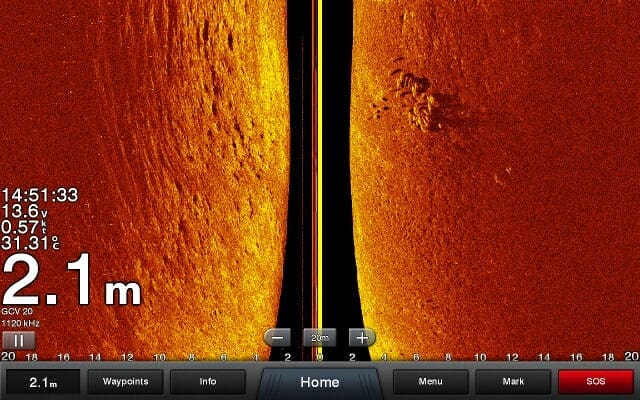
For example, in shallow-water estuaries fishing for Bream and Whiting, Bass in the lakes, Barra in northern Australia and Snook in the US, a transducer with high frequency side scan is the go. No more zig zagging round the ledges and snags and doing multiple circles to find fish. Simply drive straight up the creek looking for fish.
But as you step up in frequency, you lose the ability to see as far, because the sound waves produced by the transducer are smaller in intensity but touch a lot more objects, hence the extra clarity. So keep in mind that the higher the frequency, the more it is suited to shallower situations like fishing inshore.
Related: Barramundi Fishing 101
Which Fish Finder Should I Buy When Fishing Deeper Water?
Again, the question to ask is what transducer should I buy. To penetrate deeper water, you need a completely different transducer.
You also want to consider if you want to search new spots at depth (side scan is helpful up to about 100 m deep). But to assess those spots for fish, you’ll need the right frequency in your traditional 2D mode. In this instance, you want lower frequencies (About 455 kHz and lower) and more power (About 500W+) instead.
Using another Garmin example (we love Garmin, can’t you tell). The GT51 transducer is easily unrivaled in its ability to Side Image in deeper water. You can look for new structure out to around 150m either side of your boat! The GT51 has a dual-frequency capability in Side View. The more traditionally utilised 455 kHz and the deeper water frequency of 260 kHz.
Step 3: Choose The Sounder Head Unit For Your Sounder/Fish Finder Setup
When you’re working out what fish finder to buy, this is the part most people want to start with. But it should usually come after the transducer choice.
The first thing I want to know is whether the head unit can actually run the transducer properly. If your transducer needs 1kW, the unit needs to be able to deliver that power, or you may need a black box setup to drive it.
After that, look at the functions you’ll actually use. I usually recommend running a combo with traditional 2D, side scan and down scan as a good base.
Side scan helps you cover ground out beside the boat, while 2D and down scan help you better assess what is underneath you. They all have a job, and used together, they give you a much better picture of what is going on.

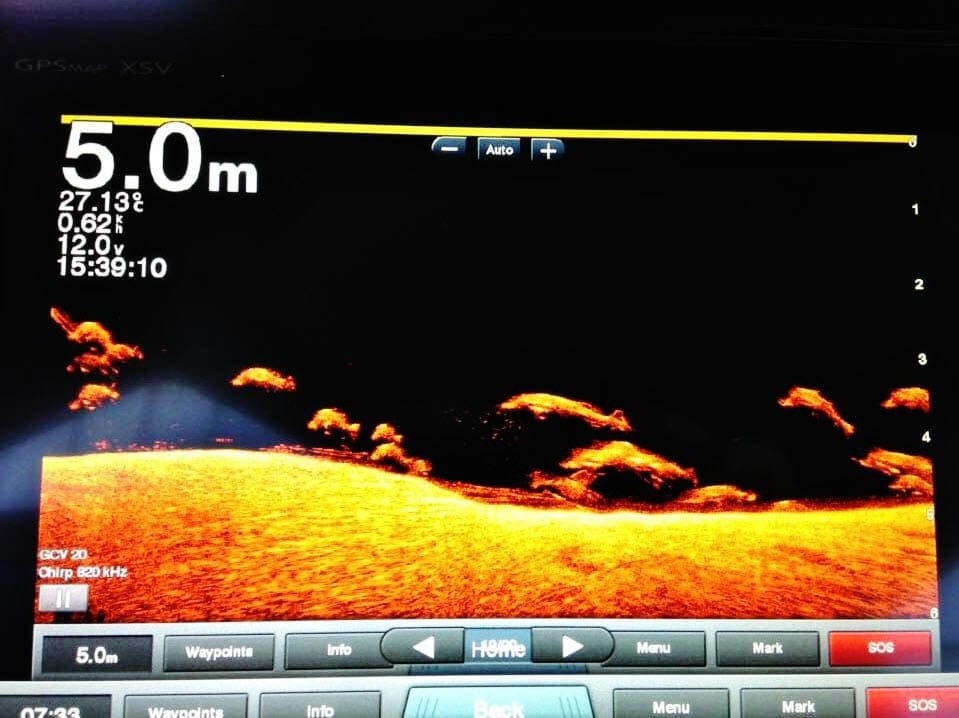
Above you can see barra around 70 to 100cm sitting in open water beside a ledge. The down image helps confirm it is a school of fish because you can see the separation between them.
Related: Finding Fish Using Side Image vs 2D
But then you have to consider things like 3D, GPS, scroll speed, better brightness, mapping and other features. These things can all be useful in the right situation. But they only matter if they suit the way you fish, and if you understand what they’re actually doing and how they’d improve your style of fishing.
That’s Where Working Out What Fish Finder to Buy Gets Confusing
As you’ve probably figured out by now, a sounder/fish finder is not just a screen with a few fancy buttons. You have different frequencies not only for each application (deep water, shallow water, searching for new ground, assessing known locations for fish) but for each mode (side scan, down scan and traditional 2D).
So before you buy a new boat sounder, it pays to know what actually matters, what suits your fishing and what is just a flashy feature you may never use.
NEWS FLASH: WHY NOT GET INSIDER INFO FROM ONE OF AUSTRALIA’S BEST FISHING EDUCATOR TO GET YOU INTO THE RIGHT SOUNDER!
AND show you how to use it with our Sounder Skills 2 course.
What fish finder should I buy can be a minefield of misinformation.
The difficulty here is that this could be a 3000-word post. Much would not apply to different readers. It really is such an individual thing.
So if you’re still wondering what fish finder to buy, and you’d like to make sure you choose the right unit and transducer for the way you fish, take a look at our Sounder Skills 2 course.
World class online training on how to use your unit.
Unlike most salespeople, Ryan has been a charter guide for 30 years and run pretty much all the brands over the years (except Lowrance).
You won’t get a heap of tech jargon from us. Just practical useful advice from people who have been using sounders every day for 30 years and has the results to prove their proficiency.
Plus we’ve been training anglers to catch more fish in less time since 2014 with great success. Even experienced anglers that have used a sounder for years are blown away by the content (See down below).
So we will make sure you get all the right info to choose the right unit and the right transducer in your price point, to maximise your success. Better still you’ll learn what is imperitive to have and what bells and whistles sound great but are not necessary if your budget is tight. You’d actually be amazed at how few functions Ryan actually uses in a modern sounder. He just uses what he has to the best of it’s ability.
This is what happens when you mix knowledge with action.
“Last week we spent a few days over at Macushla, magic weather! We had a whole tribe with us fishing and camping 5 boats in total. Needless to say, we ended up being the talk of the trip. We headed out to an area, my first time there. These same boys originally paid out on me at work when I purchased Sounder skills 2. I got the last laugh last though thanks champ. Using what I learned, we were seeing 2 fish and catching 2 fish and moving on. Stuff all fish caught throughout all other boats but man did we come home with the goods.
Anyway enough rant. Your a legend in my book and have taken many years off my learning of sounders. Heres a few pics for your time”
PETER TAIFALOS


